

Get free quotes from court interpretation near you
Takes about a minute. Free, no obligation; providers reply to you directly.
The first time I watched a court interpreter work, I thought the job was basically just “talk in two languages.” The interpreter was in the middle of a multi-defendant arraignment, whispering into a headset while the judge spoke, never pausing, never asking for a repeat. I assumed it was stressful but simple.
Then I learned she was simultaneously tracking three separate ongoing conversations, filtering out everything irrelevant, and rendering each speaker’s register — the nervous defendant’s halting speech, the DA’s legalese, the judge’s clipped efficiency — into precise Spanish equivalents with zero additions, zero omissions. Oh, and she’d arrived at 8 AM to check out equipment before her first assignment of the day.
Not simple.
The Short Version:A certified court interpreter is a trained communication officer, not just a bilingual speaker. They work three distinct interpretation modes, follow strict ethical codes, and are essential to due process under the U.S. Constitution. Hiring an uncertified interpreter isn’t just a quality risk — it can be grounds to challenge testimony.
Key Takeaways:
- Court interpreters work three modes: simultaneous, consecutive, and sight translation — each for different courtroom situations
- California certifies 12 languages at full certification; over 20 more qualify at “registered” level with lower scrutiny
- The constitutional basis for interpreter access runs through the 5th, 6th, and 14th Amendments — this is a rights issue, not a courtesy
- Assignments range from a one-minute status hearing to a trial lasting several months
The Three Modes Nobody Explains
Here’s what most people miss: “court interpreter” isn’t one job. It’s three jobs performed by one person, often in the same day.
Simultaneous interpretation is the mode you picture — the interpreter speaks in real-time while the court is in session, typically whispering into the defendant’s ear or through a headset system. This is the primary mode during hearings and trials. The interpreter is always half a sentence behind, holding the previous phrase in working memory while processing the next one. It’s cognitively exhausting in a way that’s hard to describe until you try it.
Consecutive interpretation kicks in during witness testimony. The speaker delivers a few sentences, then pauses. The interpreter renders the statement completely before the next exchange begins. This creates a clear record and allows attorneys to object before testimony proceeds. Accuracy here is critical — every word is on the record.
Sight translation handles documents. A witness is handed a written statement; the interpreter reads it aloud in the target language in real time. Contracts, police reports, medical records — anything that enters testimony as a document may require sight translation.
Pro Tip:If you’re booking an interpreter for a deposition that involves document-heavy testimony, confirm they’re comfortable with sight translation in your specific subject area. Medical malpractice depositions and immigration case reviews have very different vocabulary loads.
A Typical Day (Start to Finish)
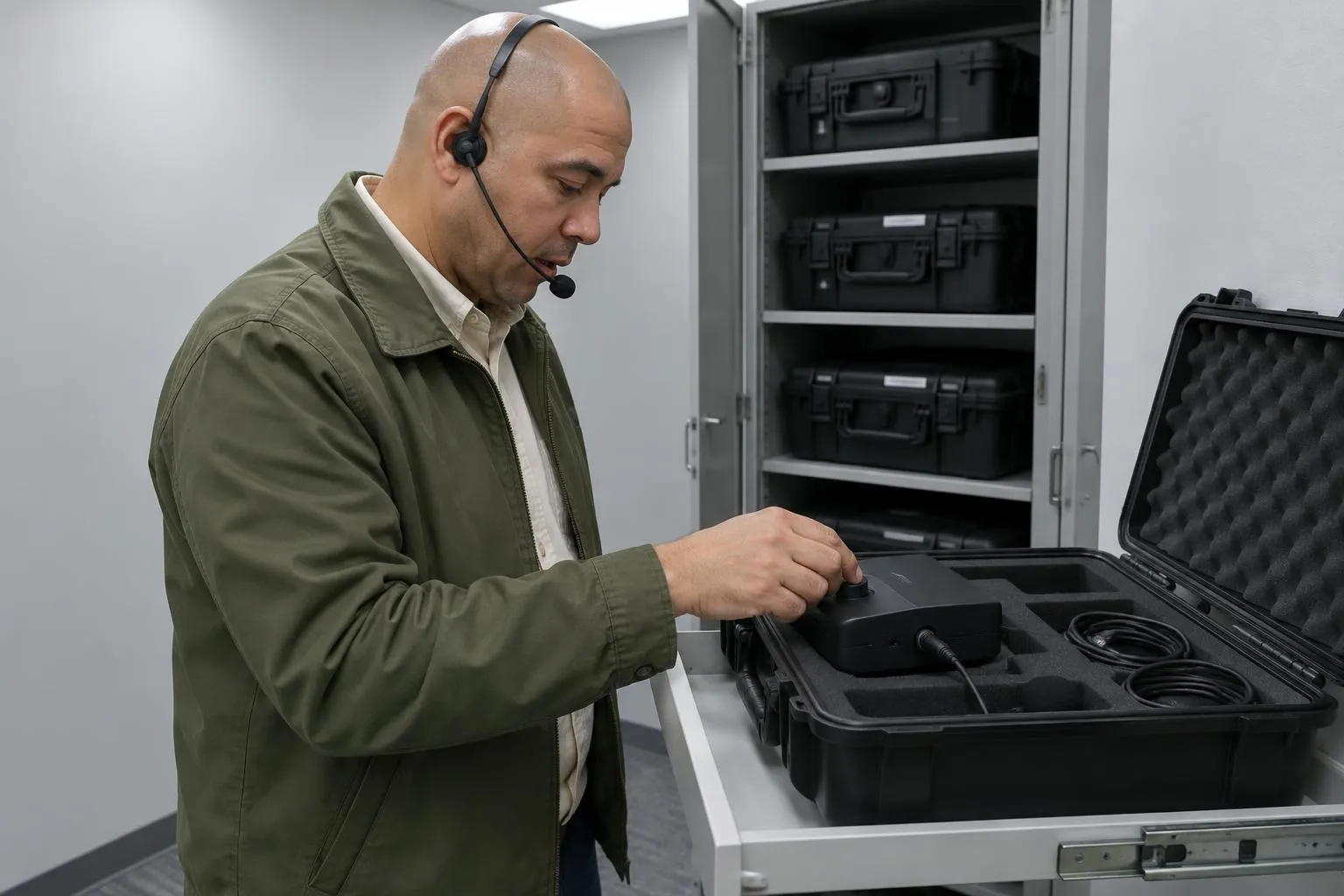
Certified court interpreter Viola Garcia describes her workday as starting between 8 and 8:30 AM — not in a courtroom, but picking up equipment. Wireless headsets, transmitters, receivers. This equipment enables simultaneous interpretation without disrupting open court, and it has to be ready before proceedings begin.
From there, the day is assignment-driven. A court interpreter might handle a one-minute bond hearing, then pivot to a suppression motion that takes two hours, then sit through jury selection in a case that will run for months. There’s no standard shift. Criminal cases, civil cases, clerk counter interactions, video hearings — all of it falls within scope.
The interpreter’s role during all of this is to be a neutral instrument. They don’t summarize. They don’t editorialize. They don’t explain cultural context unless asked and permitted to do so. If a witness uses a profanity, the interpreter uses the equivalent profanity. If a speaker is confused or incoherent, the interpretation reflects that confusion accurately.
| Mode | When Used | Key Demand |
|---|---|---|
| Simultaneous | Trials, hearings | Working memory under pressure |
| Consecutive | Witness testimony | Precision, note-taking |
| Sight Translation | Document review | Real-time reading fluency |
| Remote (video/phone) | Virtual hearings | Audio clarity, platform familiarity |
What Certification Actually Means
The legal foundation here matters. The 5th, 6th, and 14th Amendments collectively guarantee interpreter access as a due process right. That’s not a procedural nicety — it means an unqualified interpreter isn’t a budget option, it’s a constitutional exposure.
California’s certification process illustrates the bar. Candidates must pass a Written Exam (80% threshold) covering English proficiency, court terminology, and ethics. They then pass the Bilingual Interpreting Exam — four oral sections in simultaneous, consecutive, and sight translation modes, each requiring 70% or higher. California fully certifies 12 spoken languages including Spanish, Mandarin, Korean, Vietnamese, and Russian. Over 20 additional languages qualify at the “registered” level, which carries different scrutiny.
Nevada established its Certified Court Interpreter Program in 2002 under Nevada Revised Statutes 1.510. The program specifically covers interpreters serving defendants, witnesses, and litigants with limited English — anyone whose rights depend on understanding proceedings.
Reality Check:A bilingual paralegal, a family member, or a community volunteer is not a substitute for a certified interpreter in formal proceedings. Interpreted testimony can be challenged on appeal if the interpreter’s qualifications are questionable. This happens.
The Real Challenges (That Nobody Advertises)
The shortage problem is real, especially outside urban courts. Rural jurisdictions often struggle to place interpreters for less common languages, and long trials create scheduling conflicts that cascade across multiple courtrooms and cases.
California’s Judicial Council approved a Court Interpreter Workforce Pilot Program in May 2024 specifically to address this by hiring employee interpreters rather than relying entirely on freelance rosters. It’s a structural fix to a structural problem — but it’s early, and coverage gaps remain.
For less common languages, some states use reciprocity agreements. Texas BEI or RID Legal Specialist credentials, for example, may satisfy ASL interpreter requirements in courts that lack their own certification process.
The pressure of the job also compounds with case gravity. A routine traffic matter and a felony murder trial are technically the same job description. The interpreter has to perform at the same accuracy standard in both.
Practical Bottom Line
If you’re working in a legal context that requires an interpreter — whether you’re an attorney, a court administrator, or a party in proceedings — here’s the short checklist:
- Verify certification level. “Certified” and “registered” are not the same. Ask which designation applies to your language pair in your state.
- Confirm mode competency. If your matter involves significant document review, confirm sight translation experience.
- Book early for less common languages. Roster availability thins fast, especially for multi-day proceedings.
- Clarify remote vs. in-person. Video and telephone interpretation are standard now, but equipment setup and audio quality requirements differ.
For a broader primer on how to find, evaluate, and hire qualified interpreters, the Complete Guide to Certified Court Interpreters covers the full credentialing landscape, from FCICE federal certification to state-by-state roster systems.
The interpreter in that arraignment I watched? She was on her fourth case by 10 AM. The job runs quiet by design — if you notice the interpreter, something’s probably wrong. When it works, the record is clean, the defendant understands what’s happening to them, and the court moves forward. That’s the whole point.
Done reading? Get quotes from certified court interpreters near you.
Takes about a minute. Free, no obligation; providers reply to you directly.
Popular cities:
Nick built this directory to help attorneys find credentialed court interpreters without relying on court-appointed lists that are often outdated or unavailable for depositions — a gap he ran into firsthand when sourcing a last-minute interpreter for a deposition with a Spanish-speaking witness.